Supply Chains and Geopolitical Vulnerabilities
What's next possible shortness in Supply Chains


Supply Chains and Geopolitical Vulnerabilities
For decades, global supply chains were optimized around a single principle: cost minimization. Production was directed to the cheapest labor, raw materials to the lowest-priced supplier, logistics to the most efficient route. This approach generated enormous efficiency gains, drove down product prices, and raised global prosperity. But it also created an invisible yet profound vulnerability: decades of optimization had made supply chains fragile. The pandemic, climate events, and geopolitical shocks exposed this fragility with painful clarity.
Single-Point Risk: Physical Vulnerabilities
In 2021, the giant container ship Ever Given blocked the Suez Canal for six days. During that period, approximately nine billion dollars’ worth of trade ground to a halt each day. Hundreds of ships were forced to wait at both ends of the canal. Delivery delays and inventory shortages erupted across sectors ranging from flower shipments to automotive parts, from petrochemicals to consumer electronics.
What mattered about this event was not its scale but what it revealed. Twelve percent of global trade passes through a single channel. If a single physical accident could close that channel for six days, the damage from deliberate geopolitical intervention or regional conflict could be felt across a far longer timeframe and on a far wider scale.
The Houthi attacks on shipping in the Red Sea, which began in late 2023, were the real-life version of that scenario. Many major shipping companies abandoned the Suez Canal route and were forced to switch to the far longer route around the southern tip of Africa. This shift extended transit times by more than two to three weeks and drove shipping costs up dramatically.

The Semiconductor Crisis: The Anatomy of Concentration Risk
The global chip crisis of the pandemic era provided the most comprehensive and instructive example of supply chain vulnerability. A sudden surge in demand, capacity constraints at production facilities, logistics disruptions, and a drought-driven water shortage in Taiwan combined to confront the global economy with a semiconductor shortage that lasted for months.
The automotive sector was the crisis’s most striking victim. Major automakers around the world were forced to halt production of vehicles worth tens of thousands of dollars because they could not source microcontroller chips worth a few cents. Factories in the United States and Europe faced temporary closures, while the resulting production gap led to an unusual spike in used vehicle prices on the open market.
At the root of the crisis lay a structural concentration problem: more than ninety percent of the world’s most advanced logic chips were produced on a single island, in a single country. Taiwan Semiconductor Manufacturing Company (TSMC) had become virtually indispensable infrastructure for the global technology ecosystem. This concentration carried both geopolitical and physical risks — spanning a broad danger spectrum from natural disasters such as earthquakes to a potential military conflict in the Taiwan Strait.
Geopolitical Concentration: Raw Material Dependencies
Supply chain vulnerabilities are not only physical — they also carry a structural geopolitical dimension. Certain raw materials essential to the critical functions of the world economy are concentrated in a remarkably narrow geography.
Rare earth elements form the invisible backbone of modern technology infrastructure. Electric vehicle motors, wind turbines, lasers, military guidance systems, and smartphone vibration mechanisms — among many other critical applications — cannot function without these elements. More than eighty percent of global rare earth production takes place in China. The Chinese government has already demonstrated its willingness to use this strategic advantage: during a territorial dispute with Japan in 2010, it temporarily restricted rare earth exports to Japan. That restriction subjected Japan to serious economic pressure and elevated the question of raw material security for high-technology industries into a diplomatic agenda item.
Cobalt is a critical component in the production of electric vehicle batteries. Around seventy percent of global cobalt reserves lie in the Democratic Republic of Congo, and a large share of those reserves is operated by Chinese companies. Lithium is concentrated in Chile and Australia. Phosphorus, a key input for fertilizer production, comes primarily from Morocco, China, and Russia. This picture illustrates that the energy transition itself may generate new geopolitical dependencies: the shift from fossil fuels to electric systems risks replacing oil dependency with dependency on different raw materials.
Supply Chain Fragmentation: From Globalization to Regionalization
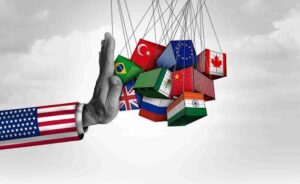
Faced with this reality, both states and companies have begun to respond with a similar instinct: shortening supply chains and diversifying them geographically. This trend is captured in two key concepts.
Reshoring refers to bringing production and the supply chain back to the home country. The US CHIPS Act of 2022 provided tens of billions of dollars in government support to companies building semiconductor fabrication plants domestically. TSMC, Intel, and Samsung all began constructing new production facilities in the US under this framework. Similarly, the European Chips Act aims to build semiconductor production capacity within the continent.
Friendshoring refers to directing production and procurement toward geopolitically reliable, values-aligned partner countries. The deepening technology and defense partnership between the US and India, and the emergence of Vietnam, Mexico, and Poland as alternative supply hubs for certain manufacturing processes, are concrete manifestations of this trend.
Both approaches entail higher costs. Transitioning from cheap global suppliers to domestic or allied suppliers may weaken price competitiveness in the short term. But this cost increase should be understood not as a loss but as a geopolitical insurance premium. The cost of a disrupted supply chain can dwarf the cost of proactive diversification many times over.
Key Takeaways for Business Leaders
Run every link in your supply chain through a geopolitical lens. Which raw materials come from which geographies, under what political conditions? Systematically reduce single-supplier or single-region dependency for critical components. When selecting suppliers, country risk, political stability, and alliance positioning must become evaluation criteria alongside price and quality.
Supply chain management is no longer solely an operational function — it is a strategic one. The best companies have already elevated this shift to board level, presenting supply chain vulnerability maps alongside scenario analyses to senior leadership on a regular basis.