Marketing; Traditional vs Digital

Executive Summary
Traditional marketing encompasses the foundational set of promotional strategies that predate the digital era. Far from being obsolete, these time-tested methods continue to generate measurable business value across industries — particularly in B2B environments where trust, credibility, and relationship depth are decisive competitive factors.
This article provides a structured, professional overview of traditional marketing: its definition, core channels, strategic advantages, comparative position against digital marketing, and its evolving role in today’s hybrid commercial landscape. Whether you are building a go-to-market strategy, advising clients, or seeking to sharpen your marketing mix, this guide delivers the analytical clarity required to make informed decisions.
- Defining Traditional Marketing
Traditional marketing refers to any form of promotion, advertising, or brand communication that operates through offline channels and media. Rooted in pre-internet business practices, it encompasses a broad spectrum of tools — from print and broadcast advertising to direct mail, public relations, telemarketing, and in-person events.
The term ‘traditional’ does not imply outdated. Rather, it distinguishes physical-world communication from digital channels. Traditional marketing is characterised by its tangibility, its reliance on established media institutions, and its proven ability to build mass awareness and enduring brand equity.
Key Defining Characteristics
- Operates through physical or broadcast media
- Typically involves higher upfront costs with broader reach
- Delivers one-to-many communication rather than personalised dialogue
- Builds credibility through institutional association (major press, TV networks, trade shows)
- Generates lasting brand impressions via repeated exposure
2. Core Channels and Tools
Traditional marketing deploys a diverse toolkit. Each channel offers distinct reach, cost structures, and audience engagement characteristics. The table below maps the primary channels alongside their formats and advantages:
| Channel | Key Formats | Core Advantages |
| Print Media | Newspapers, magazines, catalogues, brochures | High credibility; tangible; long shelf life |
| Television | TV commercials, sponsorships, infomercials | Mass reach; high impact; brand recall |
| Radio | Radio spots, programme sponsorships | Cost-effective; local targeting; high frequency |
| Outdoor (OOH) | Billboards, transit ads, posters, banners | 24/7 visibility; geographic precision |
| Direct Mail | Catalogues, postcards, personalised letters | Personalised; measurable response rates |
| Events & Trade Fairs | Industry expos, product launches, seminars | Face-to-face networking; lead qualification |
| Telemarketing | Outbound calls, appointment setting | Direct dialogue; immediate feedback |
| Public Relations | Press releases, media coverage, sponsorships | Third-party credibility; brand reputation |
Successful traditional marketing strategies rarely rely on a single channel. B2B organisations, in particular, tend to combine trade fair presence with targeted direct mail, PR campaigns, and print advertising in industry-specific publications creating multi-touchpoint strategies that reinforce brand messaging at every stage of the buyer journey.
3. Strategic Advantages of Traditional Marketing
Despite the dominance of digital in marketing budgets and industry conversation, traditional marketing retains a compelling set of strategic advantages that no serious B2B professional should dismiss.
3.1 Trust and Credibility
Print publications, television broadcasts, and high-profile events carry institutional authority. A full-page advertisement in a respected trade magazine or a presence at a leading industry expo signals financial stability, professional credibility, and long-term commitment. In sectors where supplier relationships are built over years — manufacturing, wholesale, international trade — this credibility premium is invaluable.
3.2 Tangibility and Physical Impact
Printed catalogues, product brochures, and direct mail pieces are physical objects that prospects can hold, annotate, and revisit. Research consistently shows that physical marketing materials generate stronger brand recall than digital equivalents. For product-heavy businesses — such as manufacturers, distributors, and B2B suppliers — a well-designed catalogue remains a powerful sales tool that digital cannot fully replicate.
3.3 Broad Demographic Reach
Not all decision-makers are active on LinkedIn or responsive to digital advertising. Senior executives in traditional industries — particularly in markets across the Middle East, North Africa, Central Asia, and parts of Europe — are often more receptive to in-person meetings, printed materials, and phone-based outreach than to digital campaigns. Traditional marketing meets buyers where they are.
3.4 Lower Competitive Noise
Digital advertising suffers from severe saturation. Click-through rates on display ads have fallen below 0.1% on many platforms. Traditional channels, by contrast, offer less competitive clutter. A well-crafted billboard in a strategic location or a targeted direct mail piece faces far fewer competing messages than an online banner ad.
3.5 Longevity of Exposure
A trade magazine article or a billboard runs for weeks or months. A television campaign can establish brand recognition that endures for years. Digital content, by contrast, has an extremely short half-life — social media posts typically generate 80% of their engagement within the first 48 hours. For brand-building purposes, traditional media offers superior long-term visibility.
4. Traditional vs. Digital Marketing: A Professional Comparison
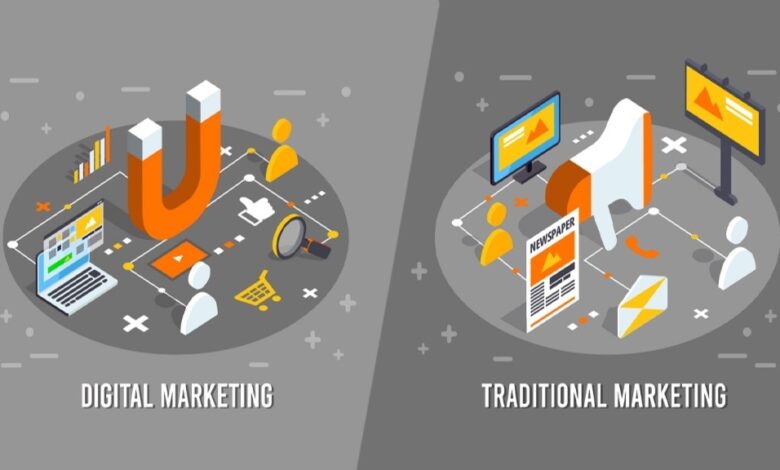
The most productive framing is not ‘traditional vs. digital’ but rather ‘when and how to deploy each.’ The table below provides a structured comparison across the key dimensions that matter to business decision-makers:
| Criteria | Traditional Marketing | Digital Marketing |
| Reach | Local / Regional / National | Global / Borderless |
| Cost | Higher upfront investment | Scalable & flexible budgets |
| Targeting | Broad demographic segments | Precise behavioural targeting |
| Measurability | Difficult to measure ROI | Real-time analytics available |
| Trust & Credibility | High – tangible & established | Variable – requires building |
| Engagement Speed | Slower campaign cycles | Instant & interactive |
| Longevity | Long shelf life (print, TV) | Short-lived unless archived |
| B2B Suitability | Excellent for relationship-based deals | Growing in B2B digital spaces |
| Best For | Brand awareness & trust at scale | Lead generation & conversions |
The data is unambiguous: both approaches serve distinct strategic purposes, and the most effective marketing programmes integrate both. The optimal balance depends on your industry, target geography, buyer profile, budget, and growth objectives.
5. Traditional Marketing in B2B Environments
Business-to-business marketing operates on fundamentally different dynamics than consumer marketing. Purchase cycles are longer, buying committees are larger, and the financial stakes of each transaction are significantly higher. In this context, traditional marketing channels remain exceptionally relevant.
5.1 Trade Fairs and Industry Exhibitions
Trade fairs are the flagship channel of B2B traditional marketing. Events such as Heimtextil (textiles), Domotex (floor coverings), Index (interiors), and sector-specific regional expos provide concentrated access to qualified buyers, distributors, and strategic partners. The face-to-face interaction enabled by exhibitions compresses relationship-building timelines and creates trust that no digital campaign can replicate at the same speed.
5.2 Printed Catalogues and Product Documentation
In B2B contexts — particularly manufacturing, wholesale, and international trade a professionally produced product catalogue remains a cornerstone sales asset. Buyers in Middle Eastern, African, and Asian markets often prefer to review physical catalogues during procurement meetings. A well-structured, bilingual catalogue positions a supplier as professional, reliable, and serious about international business.
5.3 Direct Mail and Targeted Outreach
Direct mail to a curated list of procurement managers, retail buyers, or industry contacts delivers a tangibility advantage that email cannot match. When executed with professional design and compelling messaging, direct mail commands attention and serves as a conversation opener for the sales team.
5.4 Public Relations and Industry Press
Coverage in trade publications, industry journals, and sector-specific media builds the thought leadership and market credibility that accelerates B2B sales cycles. PR delivers third-party validation — prospects trust editorial content far more than paid advertising. A feature article, an expert interview, or a research-backed white paper published in the right trade media can generate qualified inbound enquiries for months.
6. The Evolving Role of Traditional Marketing
The relationship between traditional and digital marketing has shifted from competition to complementarity. Forward-thinking organisations are deploying integrated strategies — sometimes called ‘phygital’ (physical + digital) — that leverage the strengths of both worlds.
6.1 Traditional as the Trust Anchor
Digital campaigns excel at generating awareness and traffic. But when a prospect encounters a brand’s trade fair presence, receives a premium printed catalogue, or reads about the company in an industry publication, the perception shifts from ‘online vendor’ to ‘established market player.’ Traditional marketing functions as the trust anchor that makes digital campaigns more effective.
6.2 QR Codes and Trackable Print
Modern print campaigns increasingly incorporate QR codes, custom landing pages, and unique phone numbers — transforming traditionally untrackable media into measurable digital touchpoints. This bridge technology allows marketers to capture the credibility of print while gaining the analytics of digital.
6.3 Event Marketing in the Digital Age
Industry events have been augmented by digital layers: virtual attendance options, live-streamed presentations, post-event digital catalogues, and social media amplification. The hybrid event model combines the relationship-building power of in-person contact with the global reach of digital broadcasting.
6.4 Sustainability and Premium Print
As digital noise intensifies, premium print — using sustainable materials, distinctive finishes, and sophisticated design — is experiencing a renaissance among luxury and premium B2B brands. Physical marketing materials that signal quality and attention to detail create differentiation precisely because they are rare in an age of ubiquitous digital communication.
7. Measuring Traditional Marketing Effectiveness
A common critique of traditional marketing is the difficulty of measurement. While it is true that traditional channels cannot match the granular analytics of digital platforms, sophisticated practitioners have developed robust measurement approaches.
- Unique phone numbers and dedicated URLs per channel to track response rates
- Coupon codes and promotional offers specific to printed materials
- Pre/post brand awareness surveys to measure campaign impact
- Sales data correlation with campaign timing and geography
- Trade fair lead capture forms and follow-up conversion tracking
- Media value equivalency (MVE) for PR coverage assessment
- Direct mail response rate benchmarking against industry standards
While traditional marketing measurement will never achieve the real-time precision of digital analytics, these methods provide sufficient data to justify investment and optimise channel mix over time.
- Building an Integrated Marketing Strategy
The most commercially effective approach is not to choose between traditional and digital marketing, but to design a coherent strategy that deploys each where it performs best. The following framework provides a practical starting point for B2B organisations:
Phase 1 — Foundation (Traditional)
- Define brand identity, messaging architecture, and visual standards
- Produce core sales assets: catalogues, brochures, presentation materials
- Identify and register for priority trade fairs in target markets
- Establish PR strategy: identify key trade media and build journalist relationships
Phase 2 — Amplification (Digital)
- Build digital presence: website, LinkedIn, targeted email campaigns
- Create digital versions of all print assets for online distribution
- Develop content strategy that repurposes trade press coverage
- Deploy targeted digital advertising to reach buyers between events
Phase 3 — Integration (Phygital)
- Add QR codes and trackable URLs to all print materials
- Amplify trade fair presence with social media content and live updates
- Combine direct mail with follow-up email sequences
- Use digital data to refine targeting for future traditional campaigns
Conclusion
Traditional marketing is not a relic of the past. It is a proven, strategic arsenal of tools that continues to deliver tangible commercial results — particularly in B2B contexts where trust, relationship depth, and physical presence are competitive differentiators.
The businesses that thrive in today’s complex commercial environment are those that resist the false binary of ‘traditional vs. digital’ and instead build integrated strategies that harness the credibility and reach of traditional channels alongside the precision and speed of digital platforms.
In international trade, manufacturing, wholesale, and sector-specific B2B markets, traditional marketing channels — trade fairs, printed catalogues, industry PR, direct mail, and targeted telemarketing — remain essential components of a winning market entry and growth strategy.
The future of marketing is not digital alone. It is intelligent, integrated, and purposefully multi-channel.
References
The following sources informed the research, analysis, and frameworks presented in this article. They are listed in accordance with APA 7th edition citation standards.
Books & Academic Works
Kotler, P., & Armstrong, G. (2021). Principles of Marketing (18th ed.). Pearson Education.
Kotler, P., Keller, K. L., & Chernev, A. (2022). Marketing Management (16th ed.). Pearson Education.
Ries, A., & Trout, J. (2001). Positioning: The Battle for Your Mind (20th anniversary ed.). McGraw-Hill.
Blythe, J. (2019). Principles and Practice of Marketing (4th ed.). SAGE Publications.
Belch, G. E., & Belch, M. A. (2021). Advertising and Promotion: An Integrated Marketing Communications Perspective (12th ed.). McGraw-Hill.
Fill, C., & Turnbull, S. (2019). Marketing Communications: Touchpoints, Sharing and Disruption (8th ed.). Pearson Education.
Smith, P. R., & Zook, Z. (2022). Marketing Communications: Integrating Online and Offline, Customer Engagement and Digital Technologies (7th ed.). Kogan Page.
Journal Articles
Ramsoy, T. Z., & Skov, M. (2014). Brand preference affects the threshold for perceptual awareness. Journal of Consumer Behaviour, 13(1), 1–8. https://doi.org/10.1002/cb.1451
Phelps, J., Nowak, G., & Ferrell, E. (2000). Privacy concerns and consumer willingness to provide personal information. Journal of Public Policy & Marketing, 19(1), 27–41. https://doi.org/10.1509/jppm.19.1.27.16941
Reinartz, W., Wiegand, N., & Imschloss, M. (2019). The impact of digital transformation on the retailing value chain. International Journal of Research in Marketing, 36(3), 350–366. https://doi.org/10.1016/j.ijresmar.2018.12.002
Lemon, K. N., & Verhoef, P. C. (2016). Understanding customer experience throughout the customer journey. Journal of Marketing, 80(6), 69–96. https://doi.org/10.1509/jm.15.0420
Becker, M., & Jaakkola, E. (2020). Customer journeys: A systematic literature review. Journal of the Academy of Marketing Science, 48(4), 638–656. https://doi.org/10.1007/s11747-020-00715-x
Industry Reports & Market Research
Nielsen. (2023). Annual Marketing Report: The Age of Agility. The Nielsen Company. https://www.nielsen.com/insights/
Kantar. (2023). BrandZ Global Top 100 Most Valuable Brands. Kantar Group. https://www.kantar.com/campaigns/brandz/
WARC. (2024). Global Ad Spend Outlook 2024–2025. WARC Intelligence. https://www.warc.com/
McKinsey & Company. (2023). The future of B2B sales: Hybrid selling and the digital imperative. McKinsey & Company. https://www.mckinsey.com/capabilities/growth-marketing-and-sales/
Statista Research Department. (2024). Global advertising spending 2000–2026. Statista. https://www.statista.com/statistics/273736/global-advertising-spending/
Content Marketing Institute & MarketingProfs. (2024). B2B Content Marketing Benchmarks, Budgets, and Trends. Content Marketing Institute. https://contentmarketinginstitute.com/research/





Bir Yorum